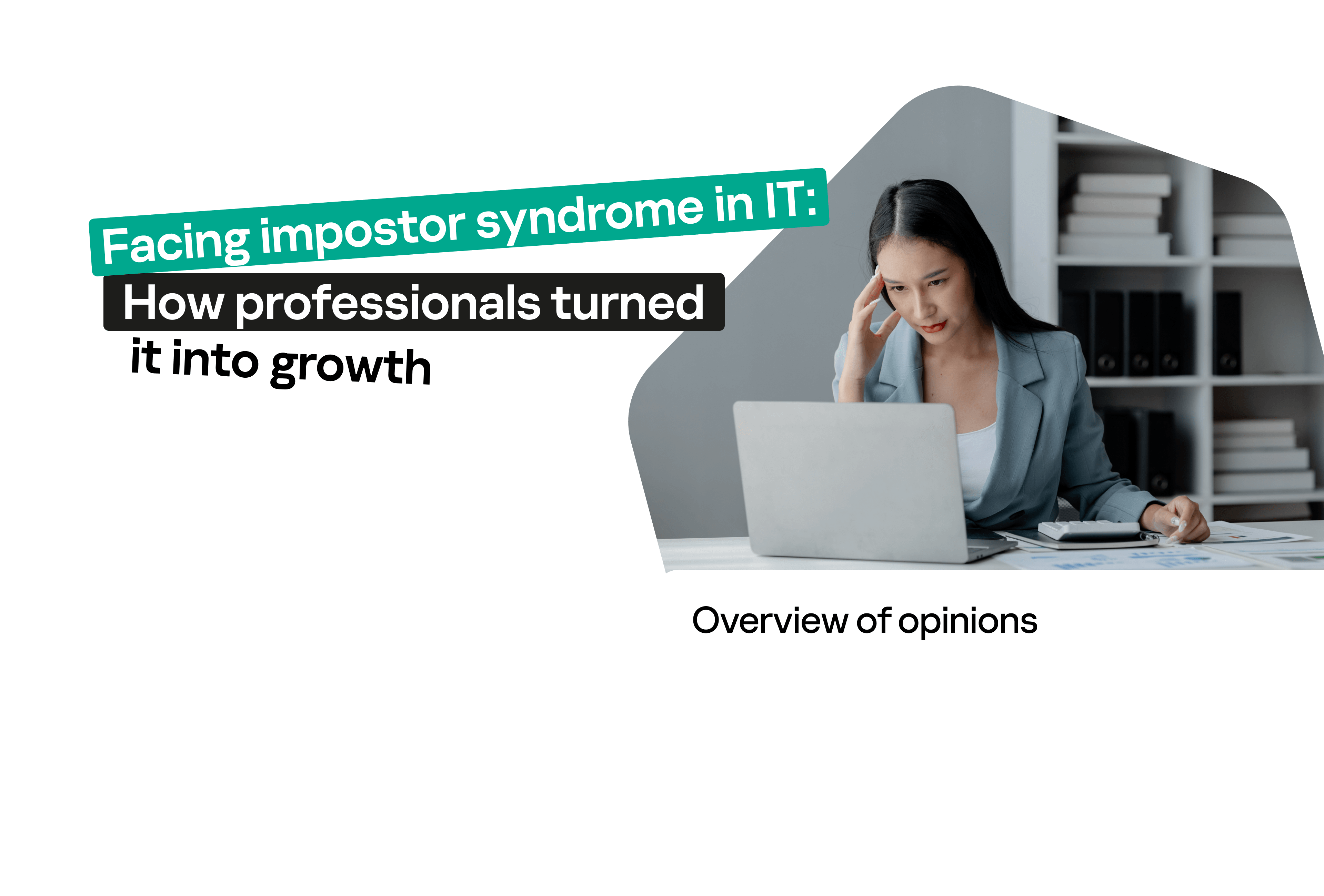
In a fast-moving industry like tech, it’s easy to feel like you’re constantly catching up. New tools, new trends, new expectations — and with them, the quiet thought that you’re not quite “expert enough.”

Many professionals in IT, including those in cybersecurity, know this feeling well. It’s called impostor syndrome — the belief that your success is undeserved, or that one day someone will “find out” you’re not as capable as they think.

In this series, Kaspersky employees share their honest experiences: when they’ve doubted themselves, what helped them overcome it, and how they’ve turned self-doubt into a source of growth and resilience.


Gladys Salmouth Head of Corporate Communications, Europe, at Kaspersky
Have you ever experienced impostor syndrome in your IT career — and how did it show up?

Yes, I’ve experienced impostor syndrome several times, especially when I first entered the IT world. Before that, I had been working in communications, but not in tech. In 2014, I decided to join an IT PR agency, and honestly, I didn’t know anything about IT at that time. I remember thinking, «Why did I take this job?» I knew everything about communications, but not about technology, and I felt like I didn’t belong.

It took time to get comfortable with the topic. But after a while, when I saw that my manager and clients were happy with my work, my confidence grew. Since then, I’ve realized that impostor syndrome tends to show up every time I take on a new role or responsibility.

Do you think impostor syndrome is more common in tech than in other industries? Why or why not?

Yes, I think it’s more common in tech, especially in industries that are still perceived as «male-dominated.» Tech and cybersecurity can look intimidating at first, but really, it’s like learning a new language. Once you start understanding the logic behind it, everything becomes much easier.

I also think confidence plays a big role. There’s this well-known idea that women often apply for jobs only when they feel overqualified, while men apply even when they don’t meet all the requirements. I experienced that myself, I almost didn’t apply for a position at a big company because I focused on the few things I didn’t have instead of the many things I could bring. My partner convinced me to try, and I got the job. It taught me that sometimes you just need someone to push you and that you shouldn’t let fear make decisions for you.

What’s been your most effective way of overcoming feelings of self-doubt?

Talking about it. Sharing my fears and doubts with people who know me well, my family, friends, or even colleagues helps a lot. They tend to be honest, but also encouraging. Most of the time, they’ll tell you, «You can do it,» and that gives you a different perspective.

Also, I’ve learned to ask for feedback directly. For example, when I was offered my current position as Head of Europe, I asked my manager why he chose me. Hearing him list the reasons, the results I achieved, the way I worked with others, helped me recognize my own value.

And above all, I remind myself that nobody ever starts a new job knowing everything. It’s a myth. Everyone learns along the way.

Do you see impostor syndrome only as a challenge, or can it also push people to grow?

For me, it’s definitely something that pushes you to grow. I actually like stepping out of my comfort zone. Impostor syndrome still happens to me sometimes, but it doesn’t last. It’s a sign that I’m challenging myself.

When I joined Kaspersky, I didn’t know much about cybersecurity. I asked a lot of questions to our researchers in France, spent time reading and learning, and after a few months, things started to click. That process made me realize that it’s okay not to know everything — the important part is being curious and willing to learn.
So yes, impostor syndrome can be uncomfortable, but if you don’t let it stop you, it becomes a great teacher.

How important are mentors, peers, or communities in helping you deal with impostor syndrome?

They’re incredibly important. Talking to people who have gone through similar experiences helps you see that everyone, no matter how senior, has doubts sometimes.

When you listen to women in tech share their stories, whether through podcasts or talks, it’s reassuring. You realize it’s normal to feel this way, and that even the most successful professionals started from a place of uncertainty. That sense of connection makes you feel less alone and gives you confidence to keep going.

At Kaspersky, I’ve also found that initiatives like Women in Tech interviews help a lot. Reading about colleagues’ career paths shows you that others have faced the same fears and still succeeded. It creates a culture of openness and mutual support.

If you could give advice to your younger self about confidence in tech, what would it be?

I used to think tech was only for men, or that it was too technical for me. Now I know that’s not true at all. The only thing I regret is not starting in IT earlier. So, my advice would be simple: dare. Try. Ask questions. Because the tech world is full of people who love sharing their knowledge, you just have to take the first step.

What’s one moment when you realized you had fully earned your place in IT?

I’m not sure there was just one moment, but I remember feeling that I truly belonged when I was able to explain complex topics to journalists that I myself hadn’t understood a few months earlier. That was a real turning point. Now, with more experience and feedback from my colleagues, I know I’m exactly where I should be.

Olga N. Kuznetsova Senior Testing Engineer at Kaspersky
Have you ever experienced impostor syndrome in your IT career — and how did it show up?

Yes, absolutely. Coming from a completely different field, I definitely experienced impostor syndrome when I first entered IT. I transitioned from the light industry, where I had been working for several years, into software testing, a world that felt completely new and unfamiliar. Unlike many of my colleagues who had formal technical education, I was self-taught. I learned through online courses, tutorials, and professional communities, and early on I earned an International Software Testing Qualifications Board (ISTQB) certification to have at least one tangible, official proof that I was qualified to work as a tester.

That period was both exciting and intimidating. I often felt like an outsider who had to run twice as fast to keep up with those who already had a computer science background. The inner voice of doubt was always there, whispering that I wasn’t «technical enough,» that I didn’t know as much as everyone else, that I needed to study more just to deserve being in the room. It wasn’t about gender or environment, it was about entering a completely new professional language and trying to prove to myself that I belonged.

Do you think impostor syndrome is more common in tech than in other industries? Why or why not?

For me, it’s more about switching into IT than about gender. Tech changes rapidly, the toolset expands constantly, and that can trigger doubts. In testing specifically, I’ve noticed women are often welcomed, especially in manual testing, because patience, attention to routine, and delivering hard feedback tactfully are valued. In automation or Software Development Engineer in Test (SDET) roles there may be more men, but overall I haven’t felt gender pressure personally. The main driver of impostor feelings was the domain change and the pace of learning.

What’s been your most effective way of overcoming feelings of self-doubt?

For me, the best way to silence self-doubt has always been evidence, something tangible that proves to both myself and others that I’m growing and making an impact. Courses, certifications, and additional training help a lot, especially at the beginning of a new stage in my career. They give structure to learning and serve as a visible proof that I’m moving forward. But what helps even more is real, hands-on work. When a product or process improves thanks to your testing, and users or colleagues say, “This is much better now”, that kind of feedback is the strongest antidote to the inner critic.

Another big factor is time and consistency. I’ve been in testing since 2016 (with a short parental break), and after nearly a decade, I can clearly see how much experience changes your self-perception. Every project completed, every issue solved, every piece of user feedback adds up. Little by little, those achievements become a solid foundation you can lean on whenever insecurity tries to sneak back in.

And finally, I’ve learned that visibility is key. Sharing knowledge, for instance, through conferences or professional communities, not only helps others but also helps me acknowledge my own growth. Preparing my upcoming presentation on testing has become a way of saying to that inner voice, “Look, my track record is real.” It’s not arrogance; it’s simply recognizing the hard work and dedication that brought me here.

Do you see impostor syndrome only as a challenge, or can it also push people to grow?

For me, it’s both. Impostor syndrome can be uncomfortable, it creates tension and a nagging voice that says, «You’re not good enough yet». But at the same time, that very discomfort can become a powerful motor for progress if you learn to control it instead of letting it control you. It’s like a background signal that keeps you alert, humble, and motivated to keep learning. Without it, it’s easy to get complacent.

I’ve learned to see it as a kind of internal compass. Whenever I start feeling impostor syndrome, it usually means I’ve stepped out of my comfort zone, into something new, bigger, and worth pursuing. It pushes me to raise the bar, study more, ask questions, and refine my skills. But the trick is to keep it in check, not let it spiral into paralysis or self-criticism.

How important are mentors, peers, or communities in helping you deal with impostor syndrome?

They’re incredibly important. Having supportive colleagues, mentors, and managers can completely change the way you see yourself and your work. Honest feedback, recognition, and even simple human encouragement help you recalibrate your self-perception so that you can see things not through the lens of self-doubt, but through reality. Sometimes you just need someone to remind you, «You’re doing great. You’ve earned your place.»

For me, feedback from users and peers has been especially powerful. When someone tells me, «Hey, this really works better now,» or «You made my job easier,» it immediately silences that inner voice that says, «Maybe I’m not enough.» Those small, genuine moments of validation remind you that your work has impact and that it’s not just lines of code or test cases, but something that makes someone’s day smoother or more efficient.

If you could give advice to your younger self about confidence in tech, what would it be?

I’d tell myself one thing: Go. Don’t hesitate. It won’t always be easy, but it will definitely be fascinating. When I first stepped into IT, I joined a small project as a business-side expert on an internal tool, acting as a bridge between users and developers. Only later did I realize that I was already doing the work of a tester, analyzing user needs, identifying bugs, helping improve the product and I genuinely loved it. That was the moment I understood that this was my place.

I would tell my younger self not to overthink it. Don’t assume that testing is a supporting role, it’s a distinct craft with its own depth, logic, and creativity. A good tester needs curiosity, analytical thinking, and the ability to see both the big picture and the tiniest details. It’s a job for those who like to ask «what if?» and find joy in uncovering the hidden parts of a system.

Tech evolves at lightning speed with different frameworks and tools, not to mention the rise of automation and AI, but that’s what makes it so exciting. If you enjoy learning and treat change as part of the journey, you’ll never get bored. So, I’d tell my younger self that I made the right call. I’d tell myself to keep learning, keep growing, and don’t let fear disguise itself as caution. You belong here.

What’s one moment when you realized you had fully earned your place in IT?

There wasn’t a single, dramatic «lightning-bolt» moment, it happened gradually, through a series of small but meaningful realizations. One of the first was when I found myself explaining testing concepts to others, things I hadn’t even understood a few months earlier. It was a quiet but powerful confirmation that I was no longer just learning; I was already contributing and helping others grow.

Then came the moments of recognition, when users thanked our team for improving their experience, when colleagues turned to me for advice, or when managers shared genuine positive feedback. Each of these experiences chipped away at that old feeling of «I’m just pretending to know what I’m doing.» They showed me that my work was bringing real value, that my knowledge had weight, and that my journey into IT had substance behind it.

And finally, being invited to speak at conferences and share what I’ve learned was another milestone. Preparing to teach others made me realize how far I’d come and that I wasn’t just repeating what I’d read, but sharing insights earned through real practice. That’s when the inner critic finally quieted down, and the thought shifted from «I’m faking it» to «I’ve earned this and I’m still growing.»

Greyce Flores Consumer Marketing Manager at Kaspersky
Have you ever experienced impostor syndrome in your IT career — and how did it show up?

Yes, the IT part of my career is actually where I felt it the most. Having spent most of my professional life in the entertainment industry, where I knew every aspect of the business and felt completely at home, shifting into tech was both exciting and intimidating.

When I first arrived in this new space, especially in cybersecurity, which is such a specific and often opaque segment I found it difficult to understand how to position and communicate it to broader audiences. It sometimes felt like being an outsider trying to find my footing in what still is, in many ways, a predominantly male industry.
There were moments when I doubted myself and whether I truly belonged and could bring value to such a technical field. But over time, I learned that a fresh perspective is exactly what innovation needs. My background in storytelling, creativity, and communication became my biggest asset, helping bridge the gap between complex technology and real human understanding.

Do you think impostor syndrome is more common in tech than in other industries? Why or why not?

For me, it definitely seems more common in tech. This industry moves incredibly fast, it’s constantly evolving, and to stay relevant, you have to keep learning, adapting, and mastering new things all the time. That pace alone can make anyone feel like they’re never fully «there» yet. Another factor is the still-visible gender imbalance. The overall lack of women in technical roles can make it harder to feel represented or confident, especially in the early stages of a career shift.

That’s why it’s been such a pleasant surprise to see so many women in leadership positions here at Kaspersky. It creates a powerful sense of belonging and shows that expertise and leadership in tech aren’t defined by gender, they’re defined by skill, passion, and persistence.

What’s been your most effective way of overcoming feelings of self-doubt?

Honestly? Just working harder. I can’t help it, it’s in my nature. There’s a quote I really identify with: «I’ve never been a natural. All I do is try, try, try.»

Whenever self-doubt creeps in, I channel that energy into action. I study more, prepare better, and keep showing up, even on the days when I don’t feel fully confident. Over time, I’ve realized that consistency and effort are the best antidotes to impostor syndrome. You don’t have to feel fearless to move forward, you just have to keep trying.

Do you see impostor syndrome only as a challenge, or can it also push people to grow?

I think it all depends on your perspective and how you choose to reframe challenging situations. Depending on your mindset, a blockage in your way can either become a stepping stone to something greater, or your tombstone.

Impostor syndrome, when seen from the right perspective, can actually push you to grow. It keeps you humble, curious, and hungry to learn. The key is not to let it paralyze you, but to let it fuel your determination to keep improving. Once you shift that mindset, what once felt like self-doubt becomes a source of drive and resilience.

How important are mentors, peers, or communities in helping you deal with impostor syndrome?

Having positive examples is incredibly important, they give you a glimpse of what you can become and show all the possibilities the future can hold. Seeing someone who has already walked a similar path helps you believe that you can do it too.

When I was considering moving into cybersecurity after spending my entire career in the entertainment industry, I had a lot of doubts. But while researching Kaspersky, I came across interviews with Luciana Lovato (Americas Channels, B2B), and she became a great reference point for me, both to better understand the business and to see what a successful woman in tech can look like.

Now, working under Marina Titova (VP, Consumer Business) and seeing the work she’s doing in Consumer Business has been another source of inspiration. She’s a leader who is firm and practical, yet also kind, approachable, and deeply competent. Having women like them in leadership roles doesn’t just help overcome impostor syndrome, it reminds you that success in tech can look like many things, and that there’s room for your version of it too.

If you could give advice to your younger self about confidence in tech, what would it be?

Trust the process. Keep learning, stay curious, and just go for it! You don’t need to have everything figured out before you start, confidence comes from experience, not the other way around.

Apply yourself, study hard, and don’t be afraid to ask questions or make mistakes. Every step, even the uncertain ones, will bring you closer to where you’re meant to be. And remember, you belong here just as much as anyone else.

What’s one moment when you realized you had fully earned your place in IT?

What I’ve learned since coming here is that if you apply yourself and work with discipline, there’s nothing you can’t conquer. I don’t think of it as a single «I’ve made it» moment, it’s more of an ongoing realization that I truly belong here.

This experience has given me lasting confidence and the certainty that, no matter what happens in life, I can stand my ground, learn what I need to learn, and keep moving forward. That, to me, is the real definition of earning your place.

Maria Isabel Manjarrez Roa Security Researcher at Kaspersky's Global Response and Analysis Team (GReAT)
Have you ever experienced impostor syndrome in your IT career — and how did it show up?

Yes, I’ve experienced impostor syndrome several times, especially early in my career. Entering the tech world, and cybersecurity in particular, can be intimidating. It’s a fast-moving, highly specialized industry, and at first, I often questioned whether I was knowledgeable enough or truly belonged here.

Now, when those feelings resurface and they sometimes still do I remind myself that expertise grows with time, and that confidence is built by showing up, learning, and contributing every day.

Do you think impostor syndrome is more common in tech than in other industries? Why or why not?

I do think it’s more common in tech because the industry moves so fast. There’s always new tools, trends and technologies to learn and that constant innovation can create pressure to «know everything.»

Even experienced professionals can feel like they’re falling behind, simply because the landscape evolves so quickly. It’s part of what makes tech so exciting, but also what makes it so demanding.

That’s why it’s so important to cultivate a mindset of continuous learning and self-compassion, to remember that no one knows it all, and that curiosity is often more valuable than certainty.

What’s been your most effective way of overcoming feelings of self-doubt?

What helps me most is focusing on progress instead of perfection. I remind myself that growth doesn’t happen overnight, it’s built step by step, through learning, mistakes, and persistence.

When I shift my attention from trying to be flawless to simply getting better each day, the pressure eases and confidence naturally follows. I’ve learned that consistency matters more than certainty and that showing up, even when you doubt yourself, is already a sign of strength.

Do you see impostor syndrome only as a challenge, or can it also push people to grow?

It’s definitely a challenge, but it can also be a motivator. Feeling a bit of impostor syndrome sometimes pushes me to keep learning, improving, and staying humble. It reminds me that there’s always room to grow and that curiosity and effort matter more than pretending to know it all. When you reframe it that way, impostor syndrome can actually become a quiet source of drive.

How important are mentors, peers, or communities in helping you deal with impostor syndrome?

They’re extremely important. Mentors help by offering perspective, guidance, and reassurance, they remind you how far you’ve come and help you see your progress more clearly. Peers, on the other hand, remind you that you’re not alone in feeling this way. Everyone, no matter how experienced, has moments of doubt.

Being part of a supportive community makes a huge difference. It creates a safe space to share experiences, exchange advice, and celebrate both small wins and big milestones. That sense of belonging builds confidence and resilience and it turns impostor syndrome from an isolating feeling into a shared human experience.

If you could give advice to your younger self about confidence in tech, what would it be?

I’d tell my younger self: you don’t have to know everything, just keep learning. It’s okay to ask questions; that’s how real growth happens. Confidence isn’t about having all the answers, it’s about staying curious, open, and willing to learn from every experience.

The tech world moves fast, and nobody ever truly «knows it all.» So, be brave enough to start, humble enough to keep learning, and confident enough to take up space, even when you’re still figuring things out.

What’s one moment when you realized you had fully earned your place in IT?

I realized it when I successfully worked on an investigation from start to finish and saw how capable I actually was of handling every part of the process. That moment made me feel confident that I could take on any task and deliver results.

Another turning point was when I started programming more. I’ve always loved coding, and by creating small scripts to solve everyday challenges at work, I began to see how my skills could make a real difference. Those small steps added up and that’s when I truly felt I had earned my place in IT.

Every story we’ve heard proves one thing: impostor syndrome doesn’t mean you’re not capable — it often means you care deeply about doing things right.

When we talk about it openly, we realize we’re far from alone. Confidence grows through experience, support, and the courage to keep learning.

At Kaspersky, we believe that by sharing these honest conversations, we can help more people recognize their worth, embrace growth, and feel empowered to thrive — both in tech and beyond.

Gladys Salmouth Head of Corporate Communications, Europe, at Kaspersky
Olga N. Kuznetsova Senior Testing Engineer at Kaspersky
Greyce Flores Consumer Marketing Manager at Kaspersky
Maria Isabel Manjarrez Roa Security Researcher at Kaspersky's Global Response and Analysis Team (GReAT)

Learn more career
insights to create a more
diverse and secure industry, championing women in cybersecurity